
Caswell County Criminal Court Cases
Caswell County criminal court cases belong to the state Judicial Branch, not to a town court. District Court handles misdemeanors, infractions, juvenile matters, and the early stages of felony cases. A felony may begin with a first appearance and other preliminary work in District Court, then move to Superior Court after indictment or another lawful charging route. Superior Court is the felony trial court. Yanceyville and Milton do not run separate municipal criminal courts.
The Clerk of Superior Court at 139 East Church Street in Yanceyville keeps both divisions' case records. The counter is open Monday through Friday from 8:30 a.m. to 5:00 p.m., and the main number is (336) 459-4000. The official Caswell County court hub also routes users to calendars, forms, local notices, and eCourts tools.
The court hub provides a clear view of the county's current Judicial Branch services.
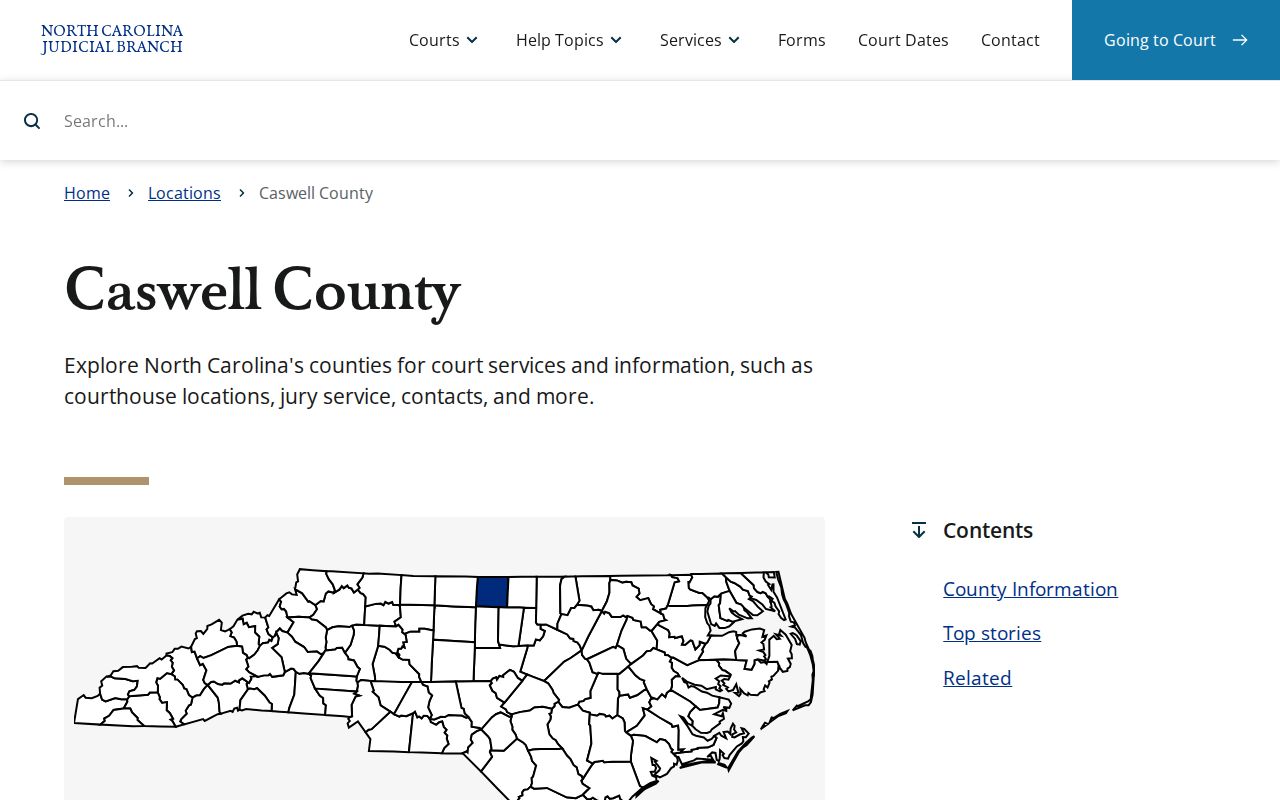
That county hub is the right starting point when a search needs both a case record and the next court date.
Caswell Court Records Joined eCourts
Caswell County joined eCourts Track 9 on July 21, 2025. That launch added remote access to public case and event data through the cloud-based Portal. It did not remove the clerk's paper files or public terminals. Older records, documents that are not attached online, and items that need certification still lead back to the courthouse.
Anonymous Portal users do not need an account to see public information. Sealed and confidential material remains hidden. District criminal proceedings also are not routinely recorded, except for specified pleas or when a judge orders recording. A request for audio from a nonconfidential recorded hearing uses form AOC-G-114. Confidential proceedings require permission and form AOC-G-115.
The Caswell court contact directory separates the clerk, judges, magistrate, district attorney, and treatment-court lines.
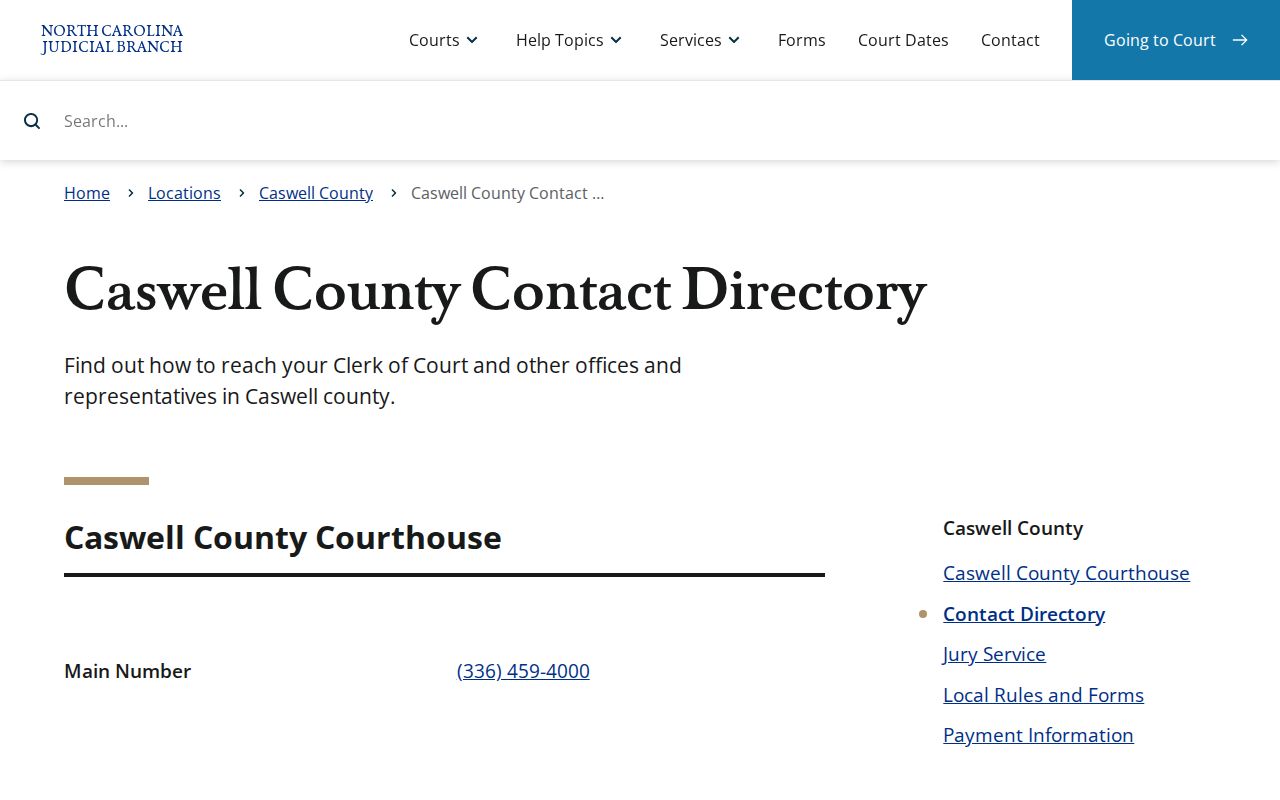
This directory helps a reader send a file request to the clerk instead of calling an office that does not hold the record.
Searching Caswell County Case Records
The North Carolina eCourts Portal is the fastest first look at a filed Caswell County case. Search by a known case number when possible. A name search can produce same-name matches, so compare the county, division, filing details, and each charge before treating a result as the right case.
- Open the eCourts Portal and choose Smart Search for public case information.
- Enter a party name, case number, citation number, attorney, business name, cross-reference number, or nickname.
- Narrow the location to Caswell County and inspect each possible match.
- Open the Case Summary or Register of Actions, then read every charge, event, hearing, and disposition separately.
- Contact the Caswell County clerk for paper documents, older entries, certified copies, or a certified name search.
| Portal field | Type | Required | Use |
|---|---|---|---|
| Party name | Text | No | Surname accepts at least three characters plus a wildcard; first name accepts one. |
| Case number | Text | No | Use at least four characters plus a wildcard when the full number is unknown. |
| Citation number | Text | No | Links a known citation to the related court matter. |
| Attorney | Text | No | Search by attorney name or bar number. |
| Location | Filter | No | Select Caswell County for a county-focused result set. |
Hearings Search offers another route when the goal is a scheduled event. It accepts case, party, attorney, judicial officer, and courtroom details.
Certified Caswell Court Record Search
The Portal is not the Judicial Branch's recommended background-check method. For a certified Caswell County name search, use form AOC-CR-314 and submit it to the Clerk of Superior Court with the $25 fee. The result is county-only and name-based. It does not search the SBI fingerprint repository, and the clerk does not use other identifiers to resolve identity.
List every name by which the subject may be known. Choose both criminal and infraction records when the full scope matters. The form warns that a no-hit result can stem from another name, a sealed record, or an unreturned warrant. It also warns that a hit can concern someone with the same or a similar name. Juvenile matters are excluded, and electronic infraction records purge five years after final disposition.
The official AOC-CR-314 form page supplies the current request document.
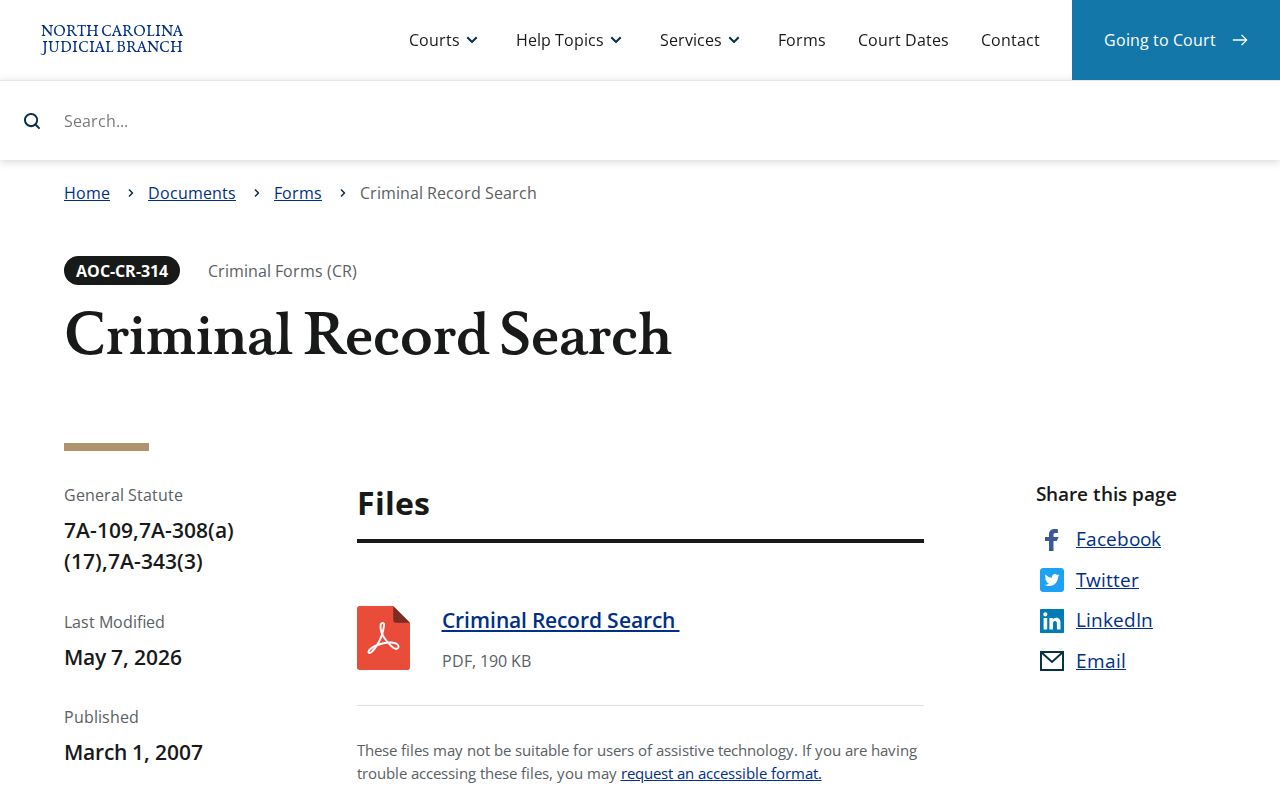
The current form should control because its revision, fields, and clerk certification marks can change.
Inside a Caswell County Case File
A public Caswell County court file focuses on the judicial case, not merely the arrest. Portal views can show a Case Summary and Register of Actions with assignments, parties, causes of action, events, dispositions, hearings, and financial information where applicable. Paper records at the clerk may contain filings that are not downloadable online.
| Case number and division | Identifies the matter, filing year, case type, county location, and District or Superior Court track. |
|---|---|
| Charges | Lists each filed offense, statute, class, and later amendment rather than relying on the booking label. |
| Process and events | May show a citation, summons, warrant, magistrate order, indictment, hearing, continuance, or failure to appear. |
| Disposition | Records outcomes such as dismissal, guilty plea, Alford plea, no contest, not guilty, or no true bill. |
| Judgment and sentence | Can include custody, probation, restitution, sentence terms, and special conditions. |
| Financial data | Shows court costs, payments, or balances when the public system makes them available. |
Note: A pending Caswell County charge is an accusation, not a finding of guilt or a final case outcome.
Reading Caswell Court Outcomes
Read each charge line, not just the case header. One count can be dismissed while another ends in judgment. A charge may also be amended between arrest and disposition. These terms mark distinct events in a Caswell County criminal court case.
- Pending
- The court has not entered a final disposition for that charge.
- Dismissed
- The charge ended without a conviction, though the arrest record may remain elsewhere.
- Guilty or Alford plea
- The court entered a conviction; an Alford plea does not use the same admission as a standard guilty plea.
- No true bill
- The grand jury did not approve the proposed indictment.
- Prayer for judgment continued
- A North Carolina disposition whose effect depends on its facts and later action.
A warrant, order for arrest, or criminal summons event may appear as issued, served, unserved, reset, or recalled. The Portal is party-based and cannot search by charge, so a charge-only inquiry should go to the clerk with more facts.
How a Caswell Criminal Case Moves
A Caswell County case may begin with an arrest, a summons, or another charging process. A magistrate handles initial process and bond when an arrest occurs. A felony defendant generally receives a first appearance in District Court, then the case may proceed through probable-cause work and indictment before a Superior Court arraignment. Misdemeanors usually stay in District Court.
Case flow: Charges Filed › Arraignment › Pretrial › Plea or Trial › Disposition › Sentencing
Motions and discovery occur before a plea or trial. Judgment and sentence follow a conviction. An appeal may create a new record in the appellate system. The Judicial Branch criminal-case overview explains these stages in plain terms.
Older Caswell Case Not Online
A missing Portal result does not prove that no Caswell County case exists. Older paper files may remain at the clerk. Spelling changes, aliases, a partial case number, sealed material, or a lag after filing can also affect results. Try known name variants and the official wildcard rules, then search a courthouse public terminal.
Call the clerk at (336) 459-4000 before traveling. Provide the case number if known, plus the full name and an approximate year. Ask whether the index is online, terminal-only, or paper-based, and whether a copy can be mailed. Public terminal searches can use defendant name, case number, and victim or witness name. Free viewing does not mean every print or certified copy is free.
The official court-record access instructions describe clerk requests and copy routes.
Those instructions support the clerk fallback when a Caswell County docket is incomplete online.
Caswell Court Payments and Records
Payment data may appear in a public Case Summary when applicable, but payment and record-copy requests are separate tasks. At the Caswell County courthouse counter, accepted forms include cash, money order, certified check, and major credit cards with a processing fee. Personal checks are not accepted. Mail payments may use a money order or certified check, but not cash or a personal check.
A payment does not by itself prove that a case is closed or that an order for arrest has been recalled. Reopen the docket or confirm status with the clerk after funds post. Use the exact file number so a payment or copy request reaches the right Caswell County criminal court case.
The Caswell County payment page lists the local options and restrictions.
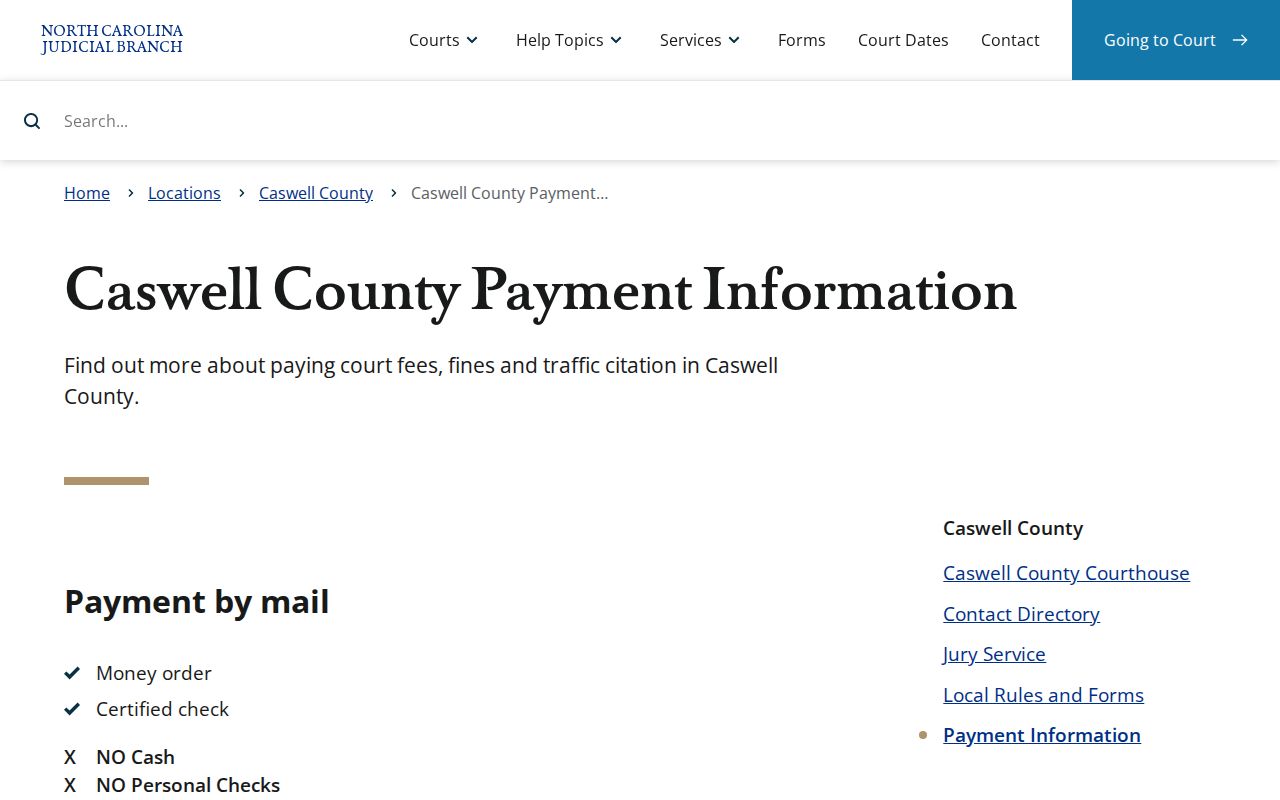
Checking that page before mailing avoids sending a form of payment the clerk cannot accept.
Case Record Access and Restrictions
North Carolina General Statute §7A-109 directs clerks to keep court records open for public inspection unless another law restricts access. Caswell County Portal views therefore exclude sealed and confidential material. Juvenile files, protected victim and minor information, financial identifiers, and expunged records do not appear like ordinary adult public cases.
The paper file may contain more than the online view, yet protected facts can still be withheld or redacted. Ask the clerk about a specific document instead of assuming the full file is remote. A certified record carries the clerk's certification and raised seal where required; a screen view does not.
Public access has limits: N.C.G.S. §7A-109 supports inspection, while Article 5 protects expunction files and other laws close juvenile or sensitive records.
When a court outcome needs to be compared with the earlier custody event, the county's arrest lookup explains why the sheriff's record and the clerk's case file may not match at the same time.